 346 262 6075
 info@firedos.com


Case study
Issues with Dead-ends in the Foam Suction Line of Foam Proportioners
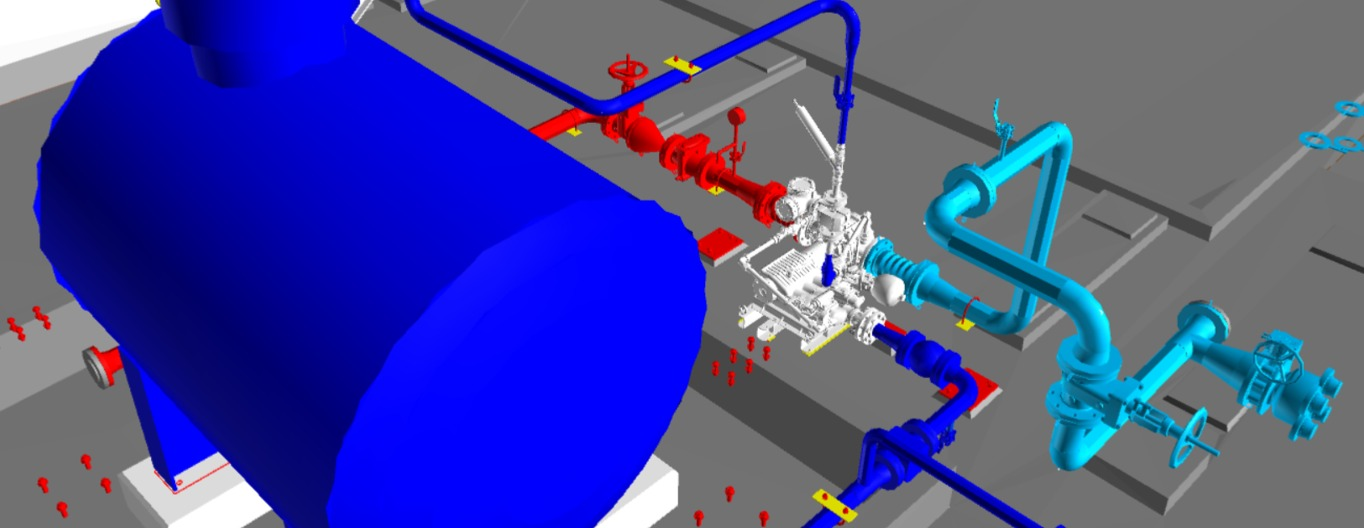
A FireDos FD3000/3‑S GEN III proportioner equipped with the latest EV valve cones was installed as part of the foam firefighting system for a fuel storage facility. The system used a fluorine‑free, non‑Newtonian shear thinning type foam concentrate.
For these types of liquids, dynamic viscosity (sometimes called absolute viscosity) is used in the calculation tables rather than relying solely on kinematic viscosity. Because the viscosity of a shear‑thinning non-Newtonian fluid is not fixed, it changes with the shear rate. As flow velocity increases, the shear rate increases and the apparent viscosity decreases; when the shear rate decreases, the viscosity rises again. Dynamic viscosity therefore provides a more realistic indication of how these types of foam behaves under actual flow conditions.
Based on the manufacturer’s viscosity data, the concentrate was expected to operate within the FireDos unit’s FM‑approved flow range without limitations. Using the same data, a detailed review of the foam concentrate suction line including pipe length, fittings, and valve configuration confirmed that the installation complied with design standards and was suitable for the selected foam concentrate.
Unexpected Performance Drop
During commissioning, the system achieved the required proportioning rate at flow rates up to 2000 LPM. However, when the flow increased beyond this point, the proportioning rate dropped below 3%, failing to meet the required performance criteria.
Refer below table for the data collected during the testing:
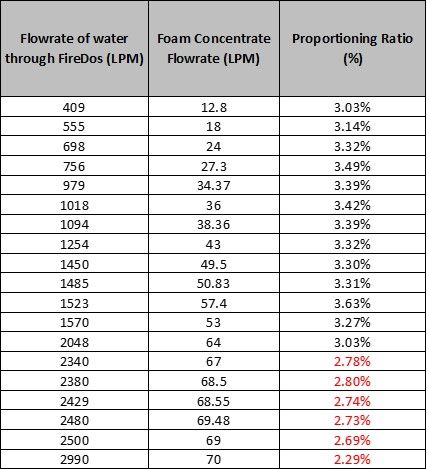
Proportioning rate under 3% for flows above 2000 LPM
This discrepancy was unexpected, as both the foam concentrate properties and the suction line design had been previously validated.
A deeper review of the general arrangement drawings revealed a critical oversight: a section of piping was acting as a dead‑end, which had not been identified during the initial design review. A dead‑end is a pipe connected to the main line but not leading to an active outlet, return, or device. With no flow through it, the fluid inside becomes static (See drawing below).
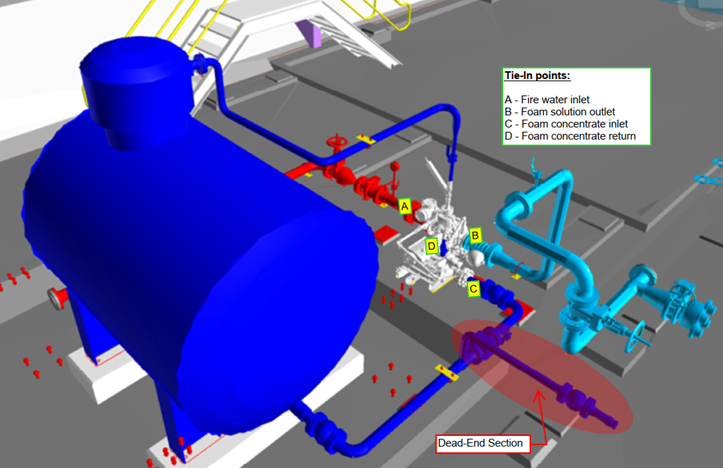
Dead-end identified in the foam concentrate suction line
Root Cause Analysis
Dead‑end pipe sections can trap air, and in foam proportioning systems, this trapped air is difficult to vent. The presence of air pockets can lead to several operational issues:
-
- Air being drawn into the FireDos pump
- Inaccurate proportioning due to inconsistent suction conditions
- Cavitation within the pump, resulting in:
-
- Excessive vibration and noise
- Reduced pump efficiency
- Potential damage to pump internals
In this case, the dead‑end acted as an air trap, allowing air to accumulate and be intermittently drawn into the proportioner at higher flow rates, causing the observed drop in performance.
Resolution
FireDos recommended relocating the isolation valve to a position directly above the tee connection, eliminating the dead‑end and minimizing the potential for air entrapment.
After the modification, a performance test was conducted at the unit’s maximum flow rate of 3000 LPM. Once the trapped air was fully vented, the system consistently achieved the required proportioning rate, confirming that air entrapment in the dead‑end section was the root cause of the earlier performance issues.
Design Recommendations for Foam Suction Line
To avoid similar issues and ensure optimal performance of foam proportioning systems, the following best practices should be applied when designing foam concentrate suction lines:
- Keep suction pipes short and straight.
- Avoid elevation changes ("ups and downs").
- Use eccentric reducers with the flat side up in horizontal suction lines
- Eliminate dead‑end sections
- When using multiple foam tanks, connect them in series.
- Provide dedicated suction lines from the foam agent tank to each foam pump.
- Perform accurate calculations to size suction pipes correctly.
- Ensure the foam tank outlet matches the suction pipe diameter.
- Use uniform pipe sizes for all fittings in the suction line.
- Do not install spring-loaded check valves or filters in suction piping.
- Ensure the entire suction line is vacuum-tight to prevent air ingress.
This might also be of interest for you:
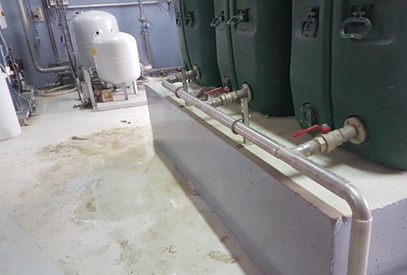
IBCS containers as foam agent tank
Learn what needs to be considered connecting an IBC as foam agent tank.
View more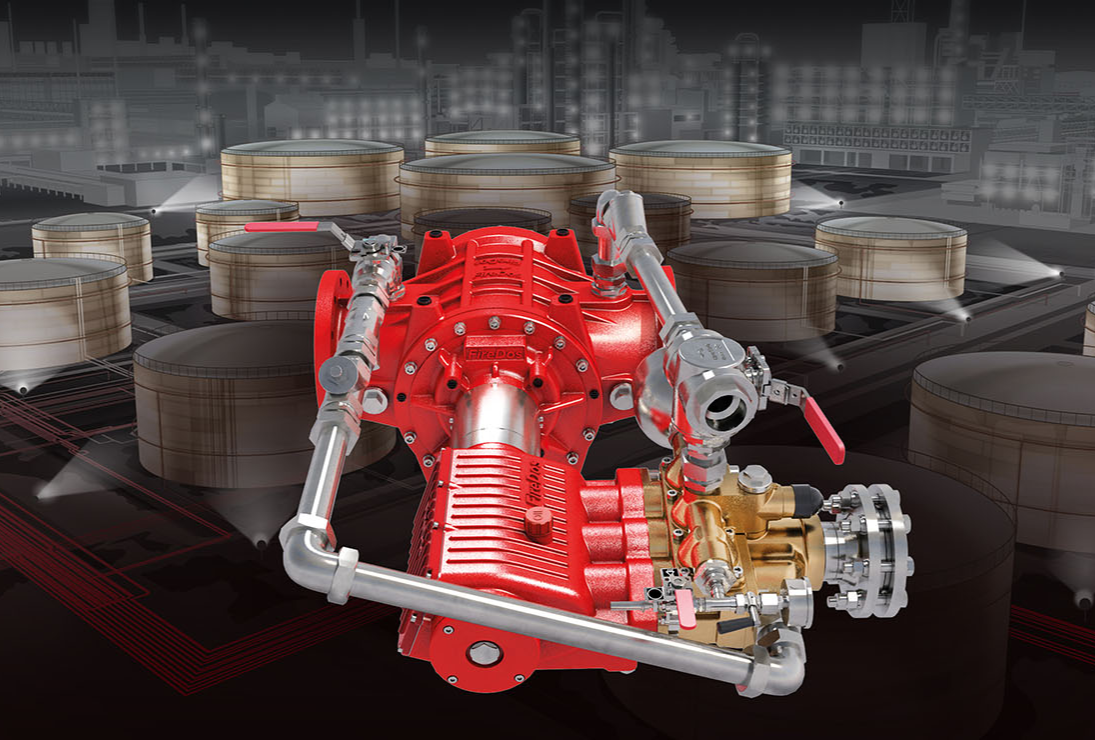
Stationary foam proportioners
Reducing costs, enhancing performance - explore the advantages
View more
FireDos Service Team: Always there for you
From planning to maintenance: We are happy to assist you.
View more