 346 262 6075
 info@firedos.com


Why engineering principles matter more than product features
Engineering principles for selecting foam proportioning technologies in stationary fire protection systems
Industrial fire protection is undergoing one of the most significant transformations in its history. The transition towards fluorine-free foam concentrates, increasing sustainability requirements, growing digitalization and greater emphasis on lifecycle engineering are changing how consulting engineers specify stationary foam fire protection systems.
As a result, selecting a foam proportioning technology has become considerably more complex than comparing hydraulic performance or initial investment costs. Today, engineers must balance operational reliability, maintainability, infrastructure requirements, future adaptability and lifecycle economics over service lives that frequently exceed twenty years.
This article does not compare manufacturers or recommend a particular proportioning technology. Instead, it proposes an engineering framework for evaluating the principal technologies used in fixed foam fire protection systems. The central premise is straightforward: In safety-critical systems, engineering decisions should be guided by principles rather than by product features. Applying this approach enables consulting engineers, EPC contractors and facility owners to identify the technology that best supports the operational objectives of each individual project.
Introduction
Few industrial systems are expected to remain inactive for years while simultaneously being required to perform flawlessly within seconds. Fixed foam fire protection systems represent one of these exceptions.
Unlike process equipment, production machinery or utility systems, fire protection installations spend most of their operational life in standby mode. Their true performance is only demonstrated during routine testing or, more importantly, during an actual emergency. For this reason, engineering decisions concerning fixed fire protection systems deserve a fundamentally different perspective from those applied to conventional industrial equipment.
Historically, selecting a foam proportioning system was often considered a relatively straightforward hydraulic exercise. The primary objective was to achieve the specified proportioning ratio over the required flow range while complying with applicable standards. Although these requirements remain essential, today's engineering environment has become significantly more demanding. Several developments are reshaping industrial fire protection:
- the global transition towards fluorine-free foam concentrates, some of which have high viscous characteristics,
- increasing expectations regarding environmental sustainability,
- digitalization of industrial facilities,
- growing emphasis on lifecycle cost,
- and higher expectations concerning long-term operational resilience.
These developments have changed the question engineers should ask.
Rather than asking: "Which proportioning technology should be specified?" the more appropriate engineering question has become: "Which engineering principles should guide technology selection for this specific application?"
This distinction is subtle but important. Engineering has never been about selecting the most sophisticated solution. It has always been about selecting the most appropriate solution. The same philosophy applies to foam proportioning systems. Every established technology currently used within industrial fire protection has evolved to solve particular engineering challenges. Each possesses strengths that make it suitable for specific operational environments.
Consequently, the objective of technology selection should not be to identify a universally superior concept. Instead, engineers should evaluate technologies against a consistent set of engineering principles that remain valid regardless of manufacturer, operating principle or system architecture. This article proposes such a framework.
Engineering objectives before technology selection
One of the most common tendencies during project development is to begin evaluating available technologies before defining the operational objectives of the protected facility. From an engineering perspective, this reverses the logical design process. Technology should always be selected to support clearly defined operational requirements not the other way around.
This principle is well established throughout mechanical engineering, process engineering and functional safety design. Before comparing proportioning technologies, consulting engineers should therefore establish the engineering objectives that the selected system must fulfil throughout its operational life. These objectives extend considerably beyond hydraulic performance.
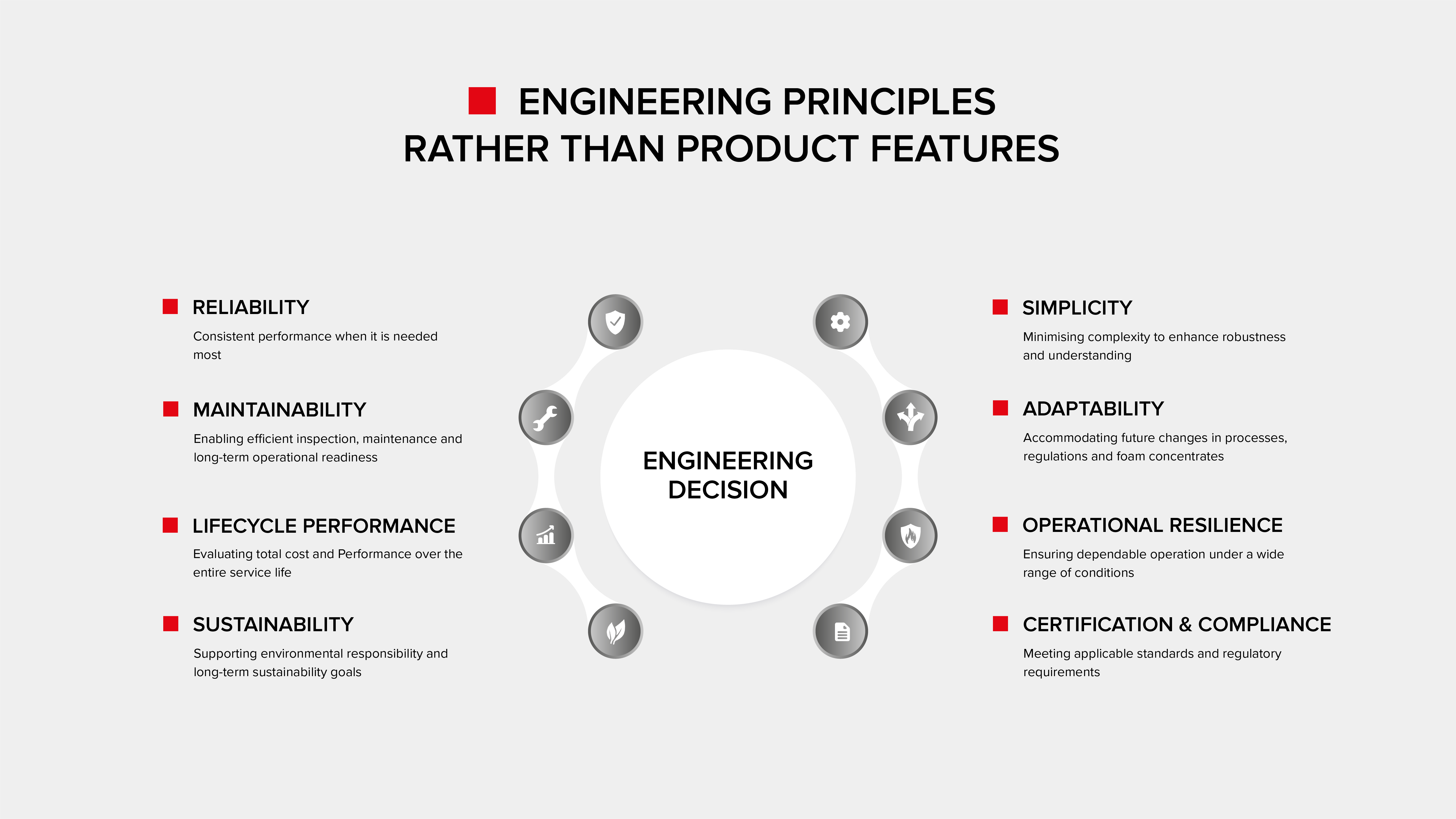
 Reliability
The primary objective of every fire protection system is dependable operation under emergency conditions. Unlike continuously operating industrial equipment, proportioning systems may remain inactive for extended periods before being required to function immediately and continuously throughout a fire event. Reliability must therefore be evaluated not only in terms of hydraulic performance but also in terms of long-term operational readiness.
 Simplicity
Throughout engineering history, simplicity has consistently proven to be an important contributor to system robustness. This does not imply that simple systems are inherently superior to complex ones. Rather, it reflects the engineering principle that every additional active component, interface, sensor, controller or software layer should provide measurable value throughout the operational life of the installation. For safety-critical systems, simplicity frequently contributes to easier inspection, more predictable maintenance and improved long-term understanding by operating personnel.
 Maintainability
Fire protection systems are long-term assets. Many installations remain operational for twenty to thirty years or longer. Consequently, maintenance should not be regarded as an operational activity occurring after commissioning. Instead, maintainability should form part of the original engineering design philosophy. Engineers should therefore consider:
- accessibility of components,
- inspection requirements,
- calibration needs,
- replacement procedures,
- expected component lifetime,
- and availability of qualified service support.
 Adaptability
Industrial facilities rarely remain unchanged throughout their operational life. Production processes evolve. Environmental regulations develop. Foam concentrates continue to change. Consequently, future adaptability has become an increasingly important engineering objective. Rather than optimizing a system exclusively for today's operating conditions, engineers should consider its ability to accommodate future developments with minimal disruption.
 Lifecycle performance
Engineering decisions should extend beyond initial capital expenditure. Over decades of operation, owners incur costs associated with inspections, maintenance, spare parts, operator training, component replacement and system upgrades. Evaluating lifecycle performance therefore provides a considerably more comprehensive basis for technology selection than acquisition cost alone.
 Operational resilience
Recent developments across multiple industries have highlighted the importance of resilient infrastructure. Fire protection systems should therefore be evaluated not only according to their normal operating characteristics but also according to their ability to continue supporting the protected facility under less favorable operating conditions. Operational resilience increasingly represents a strategic engineering objective rather than merely an operational consideration.
Taken together, these principles establish the framework within which proportioning technologies should be evaluated. Only after defining these engineering objectives does it become meaningful to compare alternative proportioning concepts. The following chapter therefore examines how today's principal foam proportioning technologies address these engineering requirements.
Engineering principles applied to today's foam proportioning technologies
The engineering principles discussed in the previous chapter provide a structured framework for evaluating foam proportioning technologies. Rather than comparing products or manufacturers, this approach examines how different engineering concepts address the operational requirements of fixed fire protection systems.
Importantly, no proportioning technology should be considered universally superior. Each has evolved to solve specific engineering challenges and reflects a particular balance between hydraulic performance, operational philosophy and lifecycle considerations.
The objective of the consulting engineer is therefore not to identify the "best" technology, but to determine which engineering approach most appropriately supports the requirements of the protected facility. The following sections illustrate how today's principal proportioning technologies address the engineering principles introduced earlier.
Reliability
Reliability remains the primary objective of every fire protection system. However, different proportioning technologies achieve reliable operation through different engineering philosophies.
- Inline proportioners achieve reliability through mechanical simplicity, provided hydraulic operating conditions remain within the design envelope.
- Balanced pressure bladder tank systems rely on well-established hydraulic principles that have been successfully applied in industrial fire protection for many decades.
- Balanced pressure pump systems achieve reliable proportioning through dedicated pumping equipment designed to maintain stable hydraulic conditions across a wide operating range.
- Electronic direct injection systems combine hydraulic performance with electronic control and continuous monitoring, allowing proportioning to adapt dynamically to changing operating conditions.
- Water motor driven mechanical systems utilize hydraulic energy directly from the extinguishing water supply, mechanically synchronizing foam concentrate delivery with water flow.
Although the underlying engineering concepts differ considerably, all technologies seek to achieve the same objective: dependable foam proportioning whenever the suppression system is required to operate.
Simplicity
Simplicity has long been recognized as an important engineering principle for safety-critical systems. This does not imply that the simplest solution is always the most appropriate. Rather, it reflects the principle that every additional active component, sensor, controller, software layer or interface should provide measurable operational value throughout the expected service life of the installation.
Different proportioning technologies therefore achieve different balances between functionality and system complexity. Some technologies intentionally minimize the number of active components through predominantly hydraulic or mechanical operating principles. Others provide additional operational capabilities through electronic control, diagnostics, automation or remote communication. The appropriate balance depends on the operational philosophy of the protected facility and the functionality expected by its owner.
Independence from supporting infrastructure
Industrial facilities differ considerably in the supporting infrastructure available during both normal operation and emergency conditions. Some installations benefit from highly reliable electrical distribution systems, redundant communication networks and integrated automation platforms. Others may operate in remote locations, offshore environments or facilities where dependence on supporting utilities is deliberately minimized.
Consequently, engineers should evaluate how proportioning technologies interact with the infrastructure available throughout the operational life of the installation. Some operating principles rely primarily on hydraulic energy, while others incorporate electrical power, electronic instrumentation or digital communication systems as integral elements of their operation. Neither approach is inherently preferable; the engineering objective is to ensure compatibility between the selected technology and the operational environment.
Maintainability
Maintenance begins during system design. Inspection intervals, accessibility of components, calibration requirements, replacement procedures and availability of technical support all influence the long-term performance of a fire protection installation. Different proportioning technologies require different maintenance philosophies. Predominantly hydraulic systems may focus on periodic mechanical inspection and functional testing. Systems incorporating electronic control may additionally require calibration, software management or verification of instrumentation. From an engineering perspective, maintainability should therefore be considered as part of the complete lifecycle strategy rather than an isolated maintenance activity.
Lifecycle performance
Fixed fire protection systems frequently remain operational for twenty years or longer. During this period, equipment will be inspected, tested, maintained and, in some cases, upgraded to accommodate changing operational requirements. Lifecycle performance therefore extends well beyond initial equipment selection. Consulting engineers increasingly evaluate technologies according to their expected behavior throughout the entire service life of the installation, considering maintenance effort, component longevity, operational continuity and long-term support. This broader perspective often provides a more meaningful basis for engineering decisions than comparison of acquisition costs alone.
Adaptability
Industrial facilities continue to evolve throughout their operational life. Environmental legislation changes. Production processes are modified. Foam concentrates continue to develop, particularly following the transition towards fluorine- free formulations. Consequently, future adaptability has become an increasingly important engineering consideration. Rather than optimizing a system exclusively for current operating conditions, engineers should evaluate how readily a proportioning technology can accommodate future developments while maintaining operational performance and regulatory compliance. Designing for adaptability contributes directly to extending asset life and reducing future modification costs.
Engineering principles before technology preference
The discussions above demonstrate that proportioning technologies should not be compared according to isolated product features or manufacturer specifications. Instead, they should be evaluated according to the engineering principles most relevant to the protected facility. Projects prioritizing digital integration may naturally favor technologies offering advanced automation and communication capabilities. Facilities placing greater emphasis on hydraulic independence, operational simplicity or long- term maintainability may arrive at different engineering conclusions.
Neither outcome represents a universally correct solution. Successful fire protection engineering results from selecting the technology whose engineering philosophy most closely aligns with the operational objectives of the installation. This distinction represents perhaps the most important principle of modern foam proportioning system design.
Engineering trade-offs in technology selection
Engineering decisions are rarely based on maximizing a single performance parameter. Instead, they require balancing multiple, and often competing, objectives. This principle is particularly relevant in fixed fire protection systems, where installations are expected to remain operational for decades while providing immediate and dependable performance under emergency conditions.
Consequently, selecting a foam proportioning technology is not simply a question of hydraulic capability or equipment specification. It is an engineering exercise in balancing trade-offs according to the operational objectives of the protected facility. The following examples illustrate some of the most common engineering trade-offs encountered during technology selection.
Simplicity versus Functionality
Modern foam proportioning technologies offer a broad spectrum of capabilities. Some systems are intentionally designed around straightforward hydraulic or mechanical operating principles, focusing on predictable operation and long- term robustness. Others incorporate advanced functionality such as variable proportioning, remote diagnostics, event logging, digital communication and integration with supervisory control systems.
These additional capabilities can provide significant operational value where they align with the overall philosophy of the facility. At the same time, every additional function should be evaluated not only according to the benefits it provides, but also according to its implications for commissioning, maintenance, long-term support and operational continuity. For safety-critical systems, functionality should therefore always be considered alongside the engineering principle of proportional complexity adding complexity only where it delivers measurable operational benefit.
Independence versus Integration
Industrial facilities differ considerably in their supporting infrastructure. Highly automated production sites may already incorporate redundant power supplies, industrial communication networks and centralized asset management systems. In such environments, integration of fire protection equipment into the wider operational architecture may offer considerable advantages.
Other facilities including remote installations, marine terminals or isolated energy infrastructure may instead prioritize operational independence, reducing reliance on external utilities wherever practical. Neither approach is universally preferable. The appropriate engineering solution depends on the infrastructure available throughout the expected service life of the installation and the operational philosophy adopted by the owner.
Initial investment versus lifecycle performance
Historically, equipment selection frequently focused on acquisition cost. Increasingly, however, industrial owners evaluate assets according to their performance over the entire operational lifecycle. For foam proportioning systems, lifecycle performance may include:
- inspection and testing activities,
- maintenance effort,
- calibration requirements,
- replacement components,
- technical support,
- operator training,
- future system modifications,
- and operational availability.
As a result, engineering evaluations are progressively shifting from capital expenditure towards Total cost of ownership (TCO) and lifecycle engineering. The most economical solution over twenty years is not necessarily the one with the lowest initial purchase price.
Standardization versus future adaptability
Industrial facilities are expected to evolve throughout their operational life. Changes in environmental legislation, operational processes and foam concentrate formulations may require modifications to existing fire protection systems. The ongoing transition towards fluorine-free foam concentrates illustrates this challenge. When selecting a proportioning technology, engineers should therefore consider not only current operational requirements but also the system's ability to accommodate future developments with minimal disruption. Designing for adaptability can contribute significantly to extending asset life while reducing future engineering effort.
Automation versus operational resiliencet
Automation continues to play an increasingly important role within industrial fire protection. Remote monitoring, diagnostic capabilities, digital communication and integration into plant-wide management systems provide valuable operational information and can support more proactive maintenance strategies. However, operational resilience should remain the primary engineering objective.
Regardless of the degree of automation employed, engineers should consider how the complete system architecture supports dependable operation throughout the expected lifecycle of the installation. This includes evaluating not only hardware performance but also supporting infrastructure, software management, component availability and long-term maintainability. Automation and resilience should therefore be viewed as complementary engineering objectives rather than competing concepts.
Balancing engineering priorities
No proportioning technology optimizes every engineering criterion simultaneously. Instead, each technology reflects a particular engineering philosophy and therefore places greater emphasis on certain operational objectives than others. For this reason, technology selection should not begin with a preferred operating principle or manufacturer.
It should begin with a clear understanding of the protected hazard, the operational philosophy of the facility and the engineering priorities that will govern the installation throughout its lifecycle. Every engineering decision ultimately represents a balance between competing objectives rather than the optimization of a single parameter. Recognizing these trade-offs allows consulting engineers to move beyond product comparisons and towards more robust, transparent and project-specific technology selection.
From Engineering Principles to Technology Selection
The engineering principles discussed in the previous chapters provide a structured framework for evaluating foam proportioning technologies. The next step is applying these principles during the engineering process. Rather than beginning with a preferred technology, consulting engineers should first establish the operational objectives of the protected facility. Technology selection should then follow these objectives through a structured and transparent decision-making process.
This approach not only improves technical consistency but also facilitates communication between owners, EPC contractors, insurers and approval authorities. The structured methodology illustrated in Figure 4 provides one example of how engineering principles can be translated into an objective and transparent technology selection process.
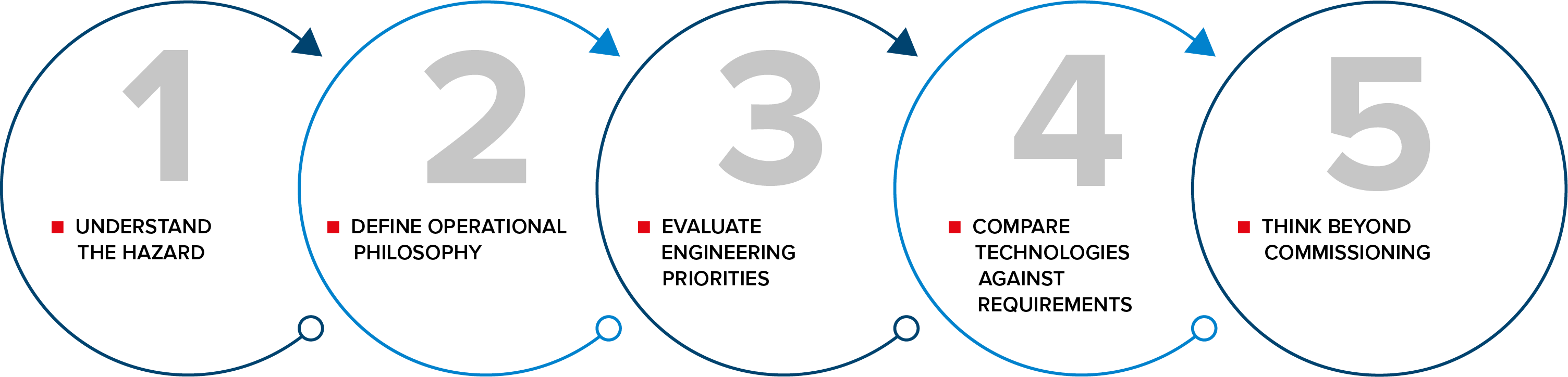
Step 1 – Understand the protected hazard
Every engineering decision begins with understanding the risk. Although two facilities may require similar discharge rates, their operational environments can differ significantly. Important considerations include:
- Nature of the protected hazard
- Fire scenarios and design basis
- Required discharge duration
- Criticality of business continuity
- Environmental conditions
- Applicable regulations and standards
These parameters establish the engineering boundary conditions before proportioning technologies are evaluated.
Step 2 – Define the operational philosophy
Technology should support the operational philosophy of the owner. Questions that should be addressed include:
- Is the facility highly automated?
- Is remote monitoring part of the maintenance strategy?
- Is simplicity prioritized over advanced functionality?
- Are maintenance resources available on site?
- Is long-term operational independence considered important?
- How frequently will system testing be performed?
Clearly defining these expectations helps prevent technology from driving the project rather than supporting it.
Step 3 – Evaluate engineering priorities
Once the operational philosophy has been established, the engineering principles introduced earlier can be applied systematically. Typical questions include:
- Which level of operational reliability is required?
- Which maintenance philosophy has been adopted?
- How important is lifecycle performance?
- What level of adaptability is expected?
- Which supporting infrastructure will remain available throughout the asset lifecycle?
- Which certification requirements apply?
These questions create an objective basis for comparing different engineering approaches.
Step 4 – Compare technologies against project requirements
Only after the engineering priorities have been defined should alternative technologies be evaluated. At this stage, engineers should resist comparing individual product features in isolation. Instead, technologies should be assessed according to how effectively they support the previously defined engineering objectives. This shifts the discussion from product preference to engineering suitability. As a result, different projects may legitimately reach different technical conclusions despite applying the same evaluation methodology.
Step 5 – Think beyond commissioning
Perhaps the most common mistake in technology selection is evaluating equipment only up to the point of commissioning. Industrial fire protection systems frequently remain operational for twenty to thirty years or more. During that period, owners may encounter:
- changing environmental legislation,
- new foam concentrates,
- component obsolescence,
- organisational changes,
- revised maintenance strategies,
- and expanding operational requirements.
Engineering decisions should therefore anticipate the complete lifecycle of the installation rather than focusing solely on initial performance.
Practical checklist for consulting engineers
Before specifying a foam proportioning technology, the following questions should be answered:
- Have the operational objectives been clearly defined?
- Which engineering principles are most important for this facility?
- Does the proposed technology support the long-term maintenance strategy?
- How will future changes in foam concentrates affect the installation?
- Are the infrastructure requirements compatible with the operational environment?
- Does the lifecycle evaluation extend beyond capital expenditure?
- Are certification and regulatory requirements fully addressed?
- Is long-term technical support available throughout the expected service life?
If these questions can be answered with confidence, the selected technology is far more likely to support the long-term objectives of the facility.
Conclusion
Selecting a foam proportioning technology for fixed fire protection systems has become significantly more complex than simply comparing hydraulic performance or equipment specifications. The transition towards fluorine-free foam concentrates, increasing digitalization, greater emphasis on sustainability and the growing importance of lifecycle engineering are changing both the questions engineers ask and the criteria they apply when making technology decisions.
As demonstrated throughout this article, every established foam proportioning technology represents a different engineering response to the same fundamental challenge: delivering the correct foam solution reliably whenever it is required. Some technologies prioritize mechanical simplicity, others operational flexibility, digital integration or hydraulic versatility. None of these approaches should be regarded as universally superior. Instead, each reflects a particular engineering philosophy developed to support specific operational requirements.
For consulting engineers, the objective is therefore not to identify a universally "best" technology, but to understand which engineering principles are most important for the protected facility and then select the technology that best aligns with those priorities. This requires moving beyond comparisons based solely on product features or acquisition cost and adopting a broader engineering perspective that considers reliability, maintainability, infrastructure requirements, adaptability, lifecycle performance and operational resilience as equally important elements of the decision-making process.
Good engineering has never been about eliminating compromise. Every engineering decision represents a balance between competing objectives. The role of the engineer is not to optimize a single parameter, but to identify the solution that delivers the most appropriate balance for the application under consideration. This principle is particularly relevant for safety-critical systems.
A foam proportioning system may remain on standby for years, yet it is expected to perform flawlessly within seconds when called upon. Such expectations demand engineering decisions that extend far beyond compliance with specifications or standards. They require an understanding of how technology, maintenance philosophy, operational environment and lifecycle considerations interact over decades of service.
Ultimately, successful fire protection is not defined by the sophistication of the technology installed. It is defined by the confidence that the system will perform exactly as intended whenever protection is required. For this reason, perhaps the most important engineering principle discussed in this article can be summarized in a single statement:
In safety-critical systems, engineering decisions should always be guided by principles rather than by product features.
This philosophy not only supports more robust technology selection but also contributes to more resilient, maintainable and sustainable fire protection systems throughout their operational life.
This might also be of interest for you:
Consulting package "Fluorine free"
Learn how to retrofit your extinguishing system to fluorine free foam agents.
View more
Stationary foam proportioners
Reducing costs, enhancing performance - explore the advantages
View more
FireDos Service Team: Always there for you
From planning to maintenance: We are happy to assist you.
View more